
Paraprofessional pipeline event wednesday marks report release and 1,100+ ISBE license milestone for parent mentors
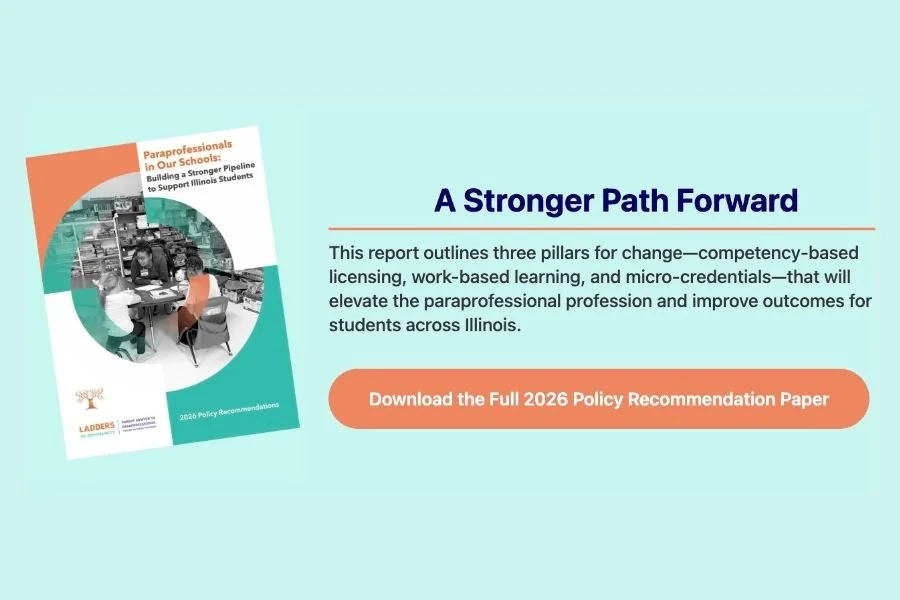
Wednesday, PEI will officially release its Paraprofessionals in Our Schools: Building a Stronger Pipeline report. View/download it here.
Parent Mentors and Principals to discuss value of hiring from the community as a new report highlights paraprofessional gaps, and ways to meet the need
More than 900 schools reported paraprofessional vacancies in the 2022-23 school year, with shortages falling hardest on schools serving Black and Latinx students.
A meeting Wednesday, June 10 will showcase one successful approach to meeting the need for paraprofessionals: the Parent Engagement Institute (PEI) Ladders of Opportunity program.
PEI honed a national model with its statewide Parent Mentor Program, a publicly-funded initiative in which more than 40,000 students receive extra attention and support in their classroom thanks to 2,000 volunteer Parent Mentors in nearly 300 partner schools in 43 school districts. In 2023, PEI created Ladders of Opportunity to help Parent Mentors take the next step toward a career in education.
“We created Ladders with the value of Parent Mentors’ lived experience and shared cultural background with their school communities very much in mind,” says Adriana Velázquez, Parent Engagement Institute Co-director. “Now that we’ve demonstrated the model works, we hope to work with the state to meet the growing need for paraprofessionals statewide.”
At the meeting Wednesday, Ladders is celebrating success with more than 1,100 former Parent Mentors having attained education credentials, many now working as special education classroom aides, substitutes and in other roles.
One of the speakers at Wednesday’s meeting will be former Parent Mentor and now substitute teacher Emma Herrera: “It only takes one person or program to open the door for you,” Herrera says. “That’s what happened to me with Ladders of Opportunity and the Parent Mentor Program. I felt lost and didn’t know if I would reach my dream of becoming a teacher.”
After serving as a Parent Mentor volunteer, Herrera worked with a Ladders coach to create an educational plan that helped her become a teacher. Ladders provides participants with study support and help transferring educational credits, and other wraparound services.
Herrera, who graduated Friday from National Louis University with her Master’s in Early Childhood Education and who will complete a bilingual certificate over the summer, plans to look for a kindergarten teacher job next.
Report: Illinois needs more paraprofessionals; recommendations to meet the need
Also at the meeting, the Parent Engagement Institute will share findings and recommendations from a new study, Paraprofessionals in Our Schools: Building a Stronger Pipeline. The 2025 Illinois Paraprofessional Roundtable, convened by PEI with Joyce Foundation support, included researchers, practitioners, and advocates from institutions including Chicago Public Schools, the University of Illinois Chicago, Advance Illinois, and Equip for Equality.
In addition to the 900 schools with paraprofessional vacancies in 2022-23 (the latest data available) findings included:
Illinois faces a persistent and inequitable shortage of paraprofessionals — including Special Education Classroom Assistants and Teacher Assistants — particularly in special education and bilingual classrooms.
Paraprofessional wages hover between $24,000 and $28,500 annually — well below Illinois' self-sufficiency standard of roughly $41,000 — fueling turnover and undermining instructional continuity.
The Roundtable intentionally brought together a cross-section of academic researchers, people with lived experience, and practitioners. Together they came up with three main policy recommendations, primarily focused on reforms at the Illinois State Board of Education (ISBE):
ISBE should add a competency-based pathway to the existing paraprofessional license, reflecting core skills in special education, early childhood development, and English learner support.
Work-based learning models — including the Parent Mentor Program — should be expanded and formally recognized as preparation pathways.
ISBE should build out a state-approved micro-credential system that appears in the Educator Licensure Information System (ELIS), giving paraprofessionals a structured, portable way to develop skills, earn recognition, and advance professionally.
Following Wednesday’s event, Parent Engagement Institute leaders say, they plan to meet with ISBE leadership to review the recommendations and hope to convene a statewide design team to develop the micro-credential framework within six months, identifying pilot districts to build an evidence base focused on student outcomes.
“Today is both a celebration and a call to action,” said Flor Dimas, co-manager of the Parent Engagement Institute’s Ladders of Opportunity paraprofessional pathway program. “We are here to celebrate the accomplishments of participants, highlight the value of highly qualified paraprofessionals, share what we learned through the Illinois Paraprofessional Roundtable, and explore how we can continue strengthening pathways into education.”
###
About PEI: A partnership betweenPalenque LSNA and theSouthwest Organizing Project, the Parent Engagement Institute (PEI) builds the capacity of community organizations, parent leaders, and schools to replicate the Parent Mentor Program model and build transformative parent leadership in schools and communities across Illinois and beyond. More at parentengagement.institute.